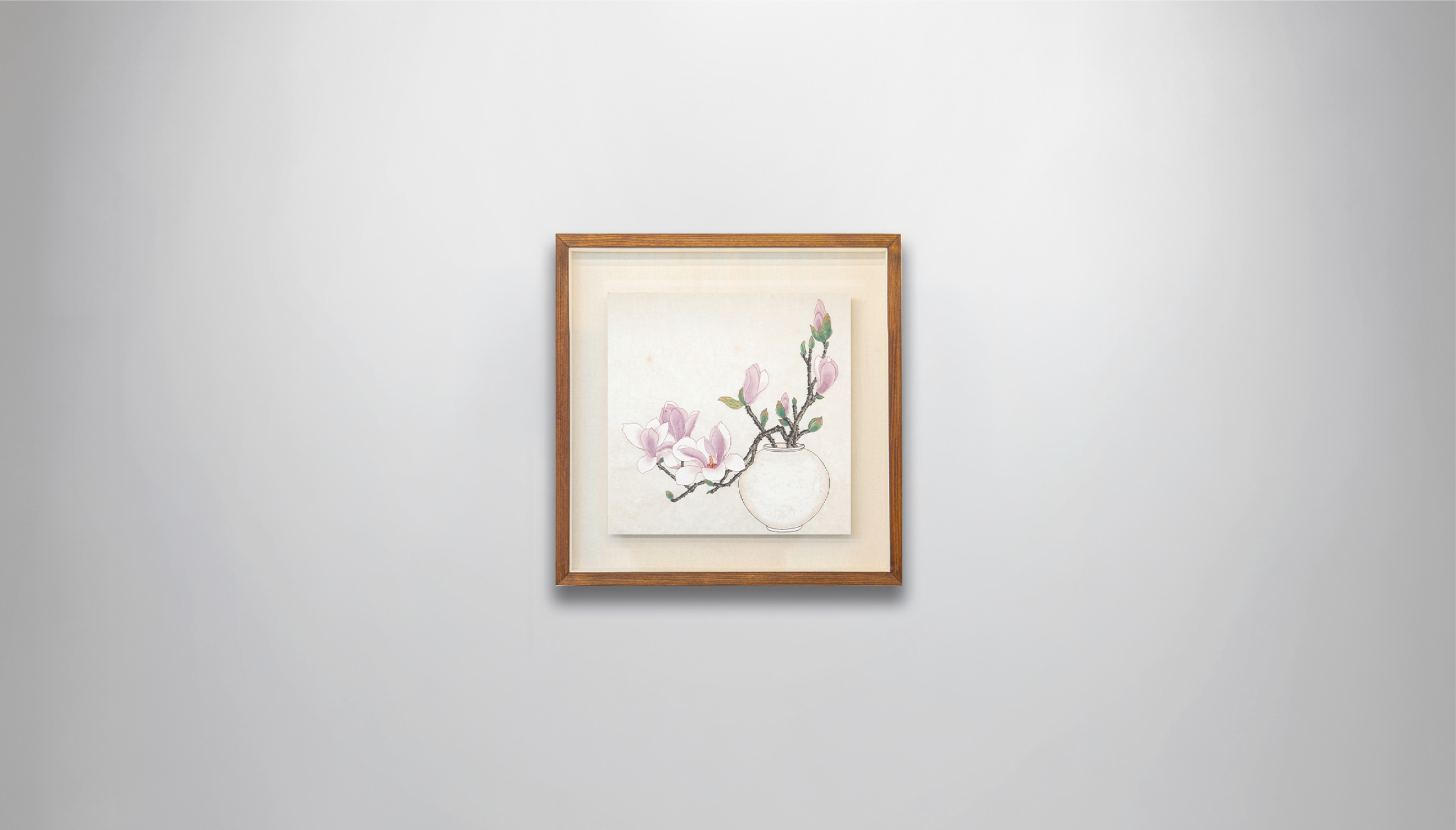
MONGNYEON DALHANGARI
Magnolia Moon Jar
목련 달항아리
Artwork dimensions exclude the frame. Items are shipped with the frame included.
Please note that dimensions may vary slightly due to the framing process.
Please allow approximately 2 to 3 weeks for delivery. Each piece is carefully packaged to ensure it arrives in perfect condition.
Magnolia and Moon Jar — Korean Heritage Painting
A talisman that gathers what is good and opens what is next — moon jar and magnolia, working in tandem. The signature porcelain of Korea's royal court — the museum world's most quoted Korean form.
Magnolia and Moon Jar brings together two names, and two of the most quietly extraordinary things Korea ever made. Magnolia — mokryeon, literally "the lotus that grows on trees" — a flower that needs no color to command an entire season. And the moon jar — dal hangari — a large white porcelain vessel, round as the full moon, wide as an open hand, holding everything and asking for nothing in return. These two meet inside a single frame. White blossoms and a white jar. Softness meeting softness. And the result is one of those rare paintings that does not announce itself but simply stops you, without warning, somewhere in the chest.
The moon jar deserves a moment of its own. It was not thrown as a perfect sphere. It was made in two halves — two separate hemispheres shaped individually and joined at the middle — which is why no moon jar is ever quite geometrically round. Each one leans slightly, settles unevenly, breathes a little asymmetrically. And because of exactly that imperfection, each one feels alive. The Korean aesthetic understood something that took the rest of the world considerably longer to articulate: that flawlessness is inert, but the almost-perfect is full of presence. The magnolia operates by the same logic. No elaborate color. No extravagant display. Just white petals opening before the leaves have even arrived, claiming the whole of early spring before anything else has had the courage to show up. Two things that need nothing added to be entirely complete. Their meeting in this painting is not coincidence.
This is not a documentary record of objects. It is an old Korean minhwa — the most Korean thing it could be: these two placed together, allowed to speak without interference. The generous curve of the moon jar and the soft opening of the magnolia petals are speaking the same language: emptiness that is actually fullness, restraint that is actually abundance, the particular peace that comes from not forcing anything. The talisman quietly carries it.
The luck and energy dimensions of this talisman are layered in ways that reward attention. The moon jar's rounded form is, in the language of feng shui, a shape that gathers rather than disperses — auspicious energy that enters a space does not scatter but collects, deepens, and stays. A moon jar in the home was understood to hold good fortune the way a jar holds water: steadily, without spilling. Wealth accumulates. Family bonds hold. The blessings that come through the door find a vessel and remain. The jar as an object has always meant this — and its image carries that talismanic spirit directly into the room that holds it. A space with a moon jar painting is a space that has been quietly designated as a vessel for auspicious things.
The magnolia brings its own specific spirit. It is, without question, the flower of new beginnings — opening before the leaves have appeared, before the season has fully committed. Tradition understood this as a powerful omen: a magnolia talisman calls in new opportunities and dissolves long-standing blockages — stuck things, delayed things, doors closed too long — the way spring dissolves snow, without force, simply by arriving. The white of the petals carries a purifying quality, clearing residual energy and making room for something fresh. When the moon jar's gathering power and the magnolia's clearing spirit work together in a single talisman, what they create in a space goes well beyond decoration.
This work has also found an unexpected moment of global recognition. Moon jars are held in the permanent collections of the Metropolitan Museum of Art in New York, the British Museum in London, and the Musée Guimet in Paris, where they are regarded as among the most significant expressions of Korean aesthetic thought ever produced. When BTS member RM spoke publicly about his personal collection of moon jars, an entirely new global audience began paying attention to what this object means and why it moves people. The minhwa version — painted with warmth, with the imperfect vitality of the traditional brush, paired with the magnolia's quiet announcement of spring — brings that world-recognized beauty off the pedestal and into the living room. Into the actual life of whoever chooses to live with it.
Magnolia and Moon Jar works in almost any space — but it has a particular gift for spaces that need to feel settled without feeling heavy. In a living room, it introduces a quality of ease and depth no furniture can manufacture. In a bedroom, it brings the clarity that makes both endings and beginnings feel possible. At an entrance, it acts as a filter — purifying what comes in, holding what is good. In a boardroom, it communicates discernment without a single word. The painting equivalent of not having to raise your voice to be heard.
Understated but inexhaustible. Simple at first glance, deeper with every return. The kind of painting that does not excite you so much as it settles you — and that turns out to be rarer and more valuable than excitement. Magnolia and Moon Jar places the two things Korean loved most quietly side by side, and lets their beauty multiply each other without interference. To own this painting is to bring into your space the full, unhurried abundance of the moon jar, the brave first opening of the magnolia, and the certainty — old and Korean and still entirely true — that a home which holds beautiful and meaningful things will, in time, be filled with them.
DISPLAY EXAMPLES
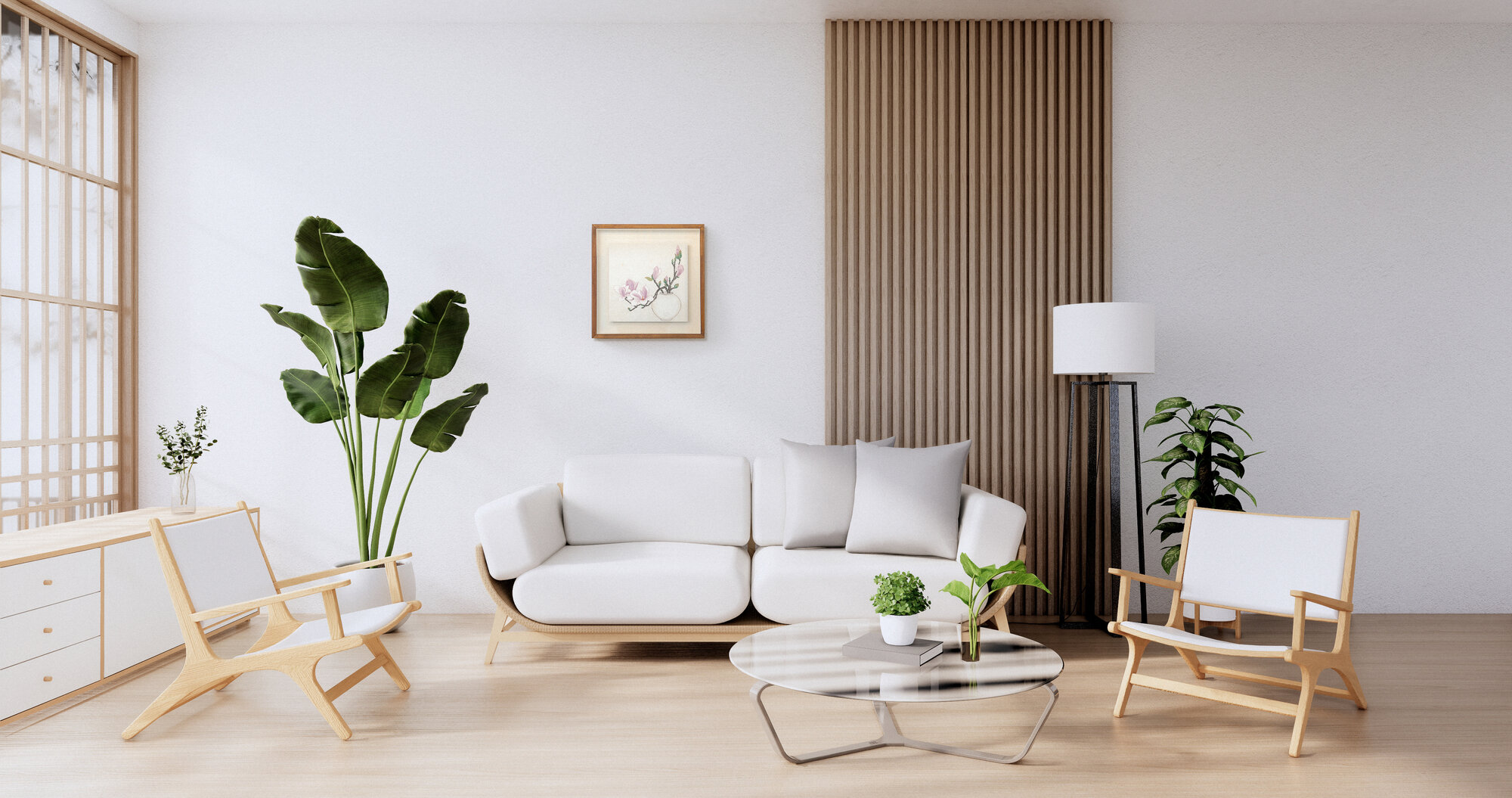
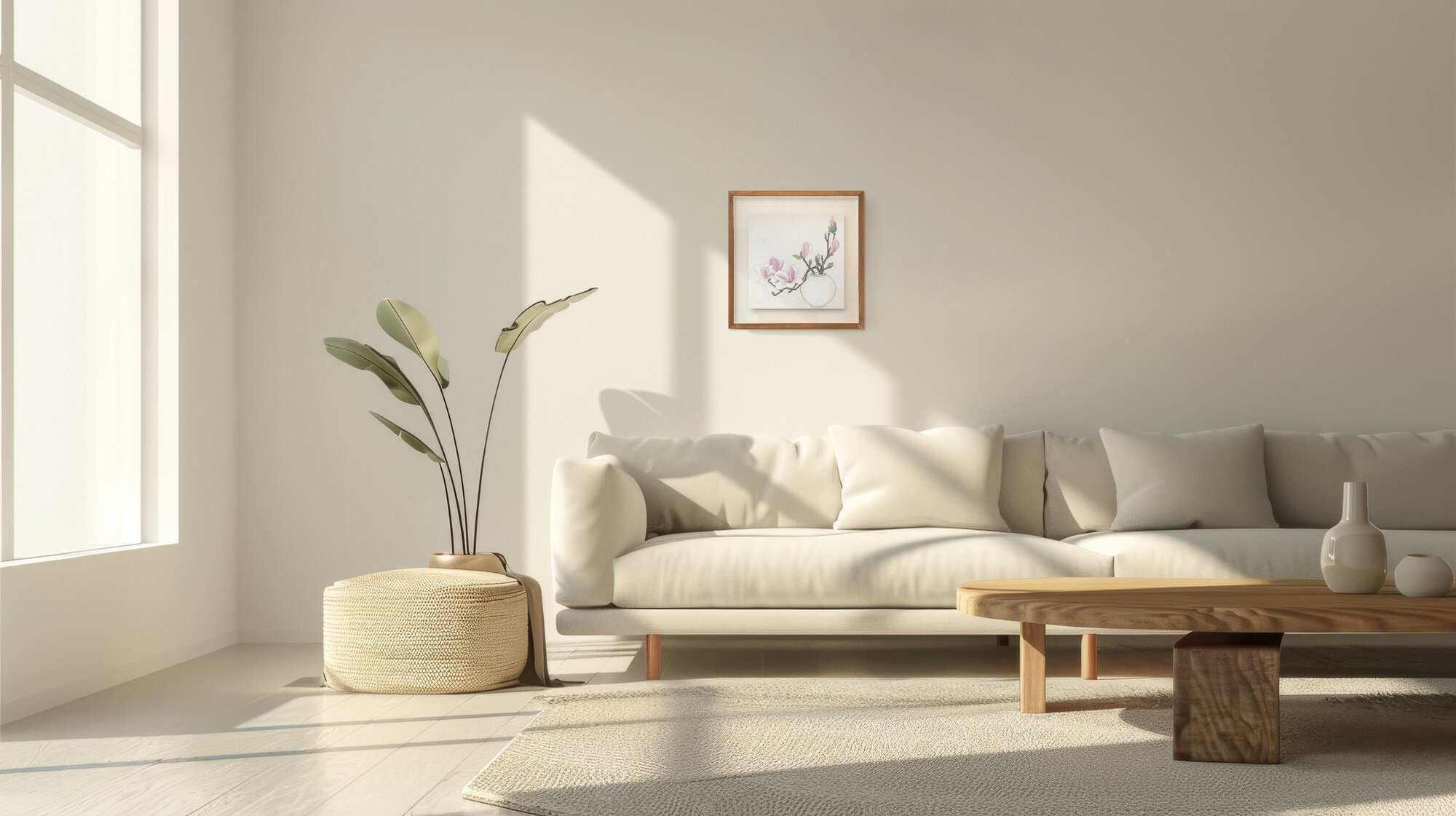
This artwork adapts beautifully to various spaces—from modern offices to traditional homes,
bringing sophistication and Korean cultural heritage to any environment.
INQUIRY BOARD
Leave a private inquiry about this artwork or any other piece. Recent inquiries from collectors are listed below.